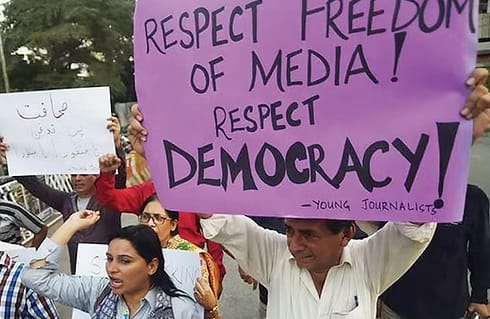

The South Asian Councillors for Human Rights, Democracy and Peace, express deep concern regarding the continuing suppression of the media and targeting of journalists by State agencies in Pakistan. Mainstream broadcast Media owners have been pressured by security agencies to take reporters and anchorpersons off the air for highlighting human rights violations. The retaliation against journalists is visible where they have exposed actions and policies of the Government that have eroded democratic values; violated Constitutional guarantees of due process; raised their voices for protection of fundamental freedoms; and protested against politically motivated persecution of those defending rights and freedoms.
Reporters and opinion-makers all over Pakistan have become victims of this systematic policy of control over the media and stifling of freedom of expression. The latest victim is journalist and human rights advocate Munizae Jahangir, who had hosted a current affairs program on a prominent news network since 2015. As with earlier instances affecting other journalists, there was also no public explanation by the media house on the cancellation of the programme. Ms. Jahangir is also the Co-Chair of the Human Rights Commission of Pakistan, the premier human rights organisation in Pakistan, and this may also explain the actions of a government bent on silencing voices that can speak truth to power.
The Councillors note that in recent years laws meant to regulate the broadcast and print media and restrict cybercrime, hate speech and blasphemy have been weaponized against journalists. This has resulted in arbitrary arrests, physical attacks, harassment, loss of employment, restrictions on the freedom of movement and, in some cases, killings and enforced disappearances.
We also note that financial pressures on the media sector that is the result of state manipulation has caused a lack of transparency or accountability within media organisations. This has adversely affected editorial independence.
Our concerns are reflected in Pakistan’s poor global rating for media freedom and for the safety of journalists. The repressive media policies adopted by successive governments driven, reportedly by the dominant security and intelligence community, have resulted in Pakistan being assessed as the most dangerous country for journalists. The erosion of media freedom in Pakistan is of concern to the entire South Asian human rights community. As the South Asians for Human Rights (SAHR) has stated with regard to challenges facing the Pakistani media: “A free press is an indispensable pillar of any democratic society, and it serves as a vital safeguard for transparency, accountability, and the protection of human rights”.
We join SAHR in reminding the Government of Pakistan of its legal obligations and moral responsibility to respect, protect and fulfil the rights to freedom of expression and access to information. It is high time that the State and all its institutions make a commitment to reverse the repression of media, take effective measures to ensure the physical and economic security of journalists, and refrain from motivated attacks against their reputation or professional credibility.
We strongly urge the international community, including the United Nations Special Rapporteur on the Freedom of Opinion and Expression as well as the United Nations Human Rights Committee to lend their voices for freedom of expression and protection of journalists against targeted harm in Pakistan.
Signatories:
- Hina Jilani, Pakistan
- Sultana Kamal, Bangladesh
- Dr. Hameeda Hossain, Bangladesh
- Dr. Syeda Hameed, India
- Kanak Mani Dixit, Nepal
- Dr. Sima Samar, Afghanistan