
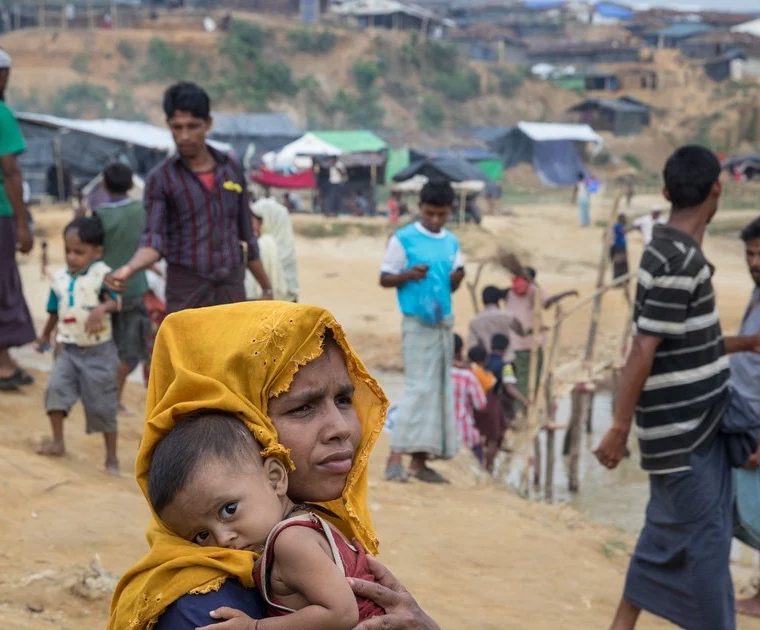

South Asians for Human Rights (SAHR), a regional network of human rights defenders, is profoundly concerned over the ever – increasing number of refugees, asylum seekers, stateless people, and Internally Displaced People (IDPs) across South Asia, who have been forced to flee their homes in search of safety, dignity, and protection. People are displaced by a variety of interconnected factors in South Asia- armed conflict, political persecution, ethnic and religious violence, gender-based discrimination, and persistent violations of human rights. Increasingly, the adverse effects of climate change are exacerbating existing vulnerabilities and contributing to new forms of displacement across the world. Yet existing national legal frameworks remain minimal and inadequate in addressing the needs and rights of these refugees and asylum seekers.
Today, South Asian countries collectively host millions of refugees, asylum seekers, and internally displaced persons, reflecting the region’s complex displacement landscape.
At present, Bangladesh continues to shoulder the immense responsibility of hosting 1.2 million Rohingya refugees in Cox’s Bazar, one of the largest refugee settlements in the world. Pakistan remains home to about 460,400 refugees, with a majority of Afghan refugees. The experience of Bhutanese refugees of Nepali origin remains one of South Asia’s most significant protracted crises over four decades. Although large-scale third-country resettlement has provided durable solutions for many, the legacy of displacement, statelessness, and unresolved questions of identity and justice continue to affect those impacted. Tibetan refugees residing in South Asia for more than six decades underscore an important reminder of the need for rights-based, durable solutions for all displaced populations in the region.
Except for Afghanistan, other countries in South Asia are not signatories to the 1951 Convention Relating to the Status of Refugees or its 1967 Protocol. As a result, refugees are often managed through ad hoc administrative arrangements rather than clear legal standards. The downsizing and phasing-down of the UNHCR from the South Asian region in recent times have further complicated the landscape, as formal registration and resettlement processes have largely ceased. In many contexts, with regard to basic human rights standards, refugees, asylum seekers and the externally displaced persons are treated under laws governing irregular migration, leaving them vulnerable to arbitrary decision-making, prolonged uncertainty, detention, and discrimination. At the same time, the absence of a formal legal framework has also created challenges relating to documentation, registration, and public confidence in migration governance.
Yet, based on humanitarian grounds, States remain obligated to uphold the fundamental rights and dignity of all refugees within their jurisdiction, regardless of their migration status. These obligations include non-refoulement, ending arbitrary detainment, protecting the right to life, ensuring freedom from torture and discrimination, safeguarding access to healthcare and education, preserving family unity, and protecting women and children from exploitation and abuse, among other things.
South Asian countries have generally relied on bilateral refugee policies between origin and host countries-as has been the case in the ongoing bilateral negotiations between Afghanistan and Pakistan. As evidenced by ongoing disagreements between Bhutan and Nepal, Afghanistan and Pakistan, and Bangladesh and Pakistan, the issue of refugees in South Asia is contentious.
The challenges of displacement in South Asia are neither temporary nor isolated; they continue to evolve and affect millions of lives across the region. Therefore, nations in the region should not preclude the adoption of humane, rights-respecting approaches that uphold the dignity, protection, and well-being of refugees and asylum seekers.
SAHR calls upon the governments of South Asia to:
- Provide access to education, healthcare, and financial services to refugees and asylum seekers.
- Ensure access to livelihood opportunities and labour markets, enabling refugees and asylum seekers to generate income to achieve a dignified living standard and contribute to local and national economies;
- Develop a specific South Asian regional refugee protection framework grounded in shared responsibility, human rights, and regional solidarity;
- Call on the Global North to uphold their responsibility-sharing commitments by providing sustained and adequate funding to UNHCR and other humanitarian agencies assisting refugees and asylum seekers;
- Advocate for greater international burden-sharing and financial support so that host communities are not left to bear disproportionate costs;
- Explore durable solutions, including voluntary repatriation, local integration where appropriate, and resettlement pathways consistent with international human rights standards;
- Develop regional responses to climate-induced displacement and planned relocation consistent with human rights standards; and
- Consider accession to the 1951 Convention and 1967 Protocol while developing context- specific regional protection mechanisms.