
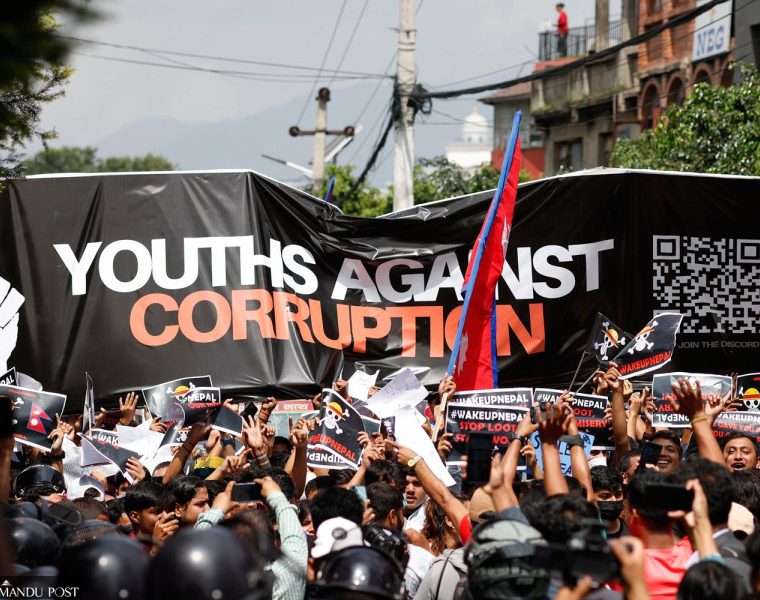

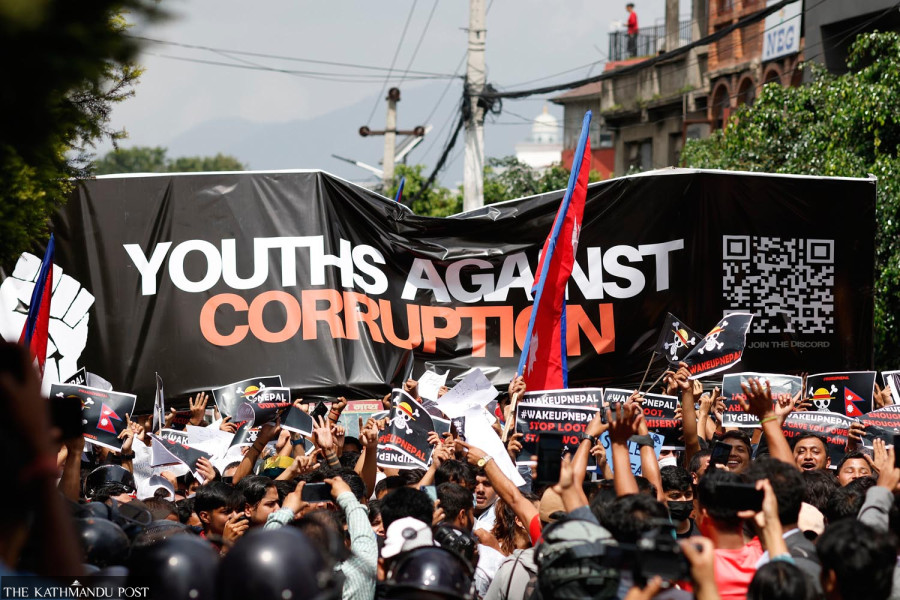
Following the unprecedented ‘Gen Z’-led youth uprising in Nepal in September 2025 and its violent aftermath, South Asians for Human Rights (SAHR), a regional network of human rights defenders, expresses grave concern over the country’s political and constitutional future. Testimonies from a wide range of respondents reflect deep-seated public frustration with the lack of accountability across all levels of government and state; anger at the K. P. Sharma Oli government’s violent response to the protests, which werefollowed by coordinated attacks on public institutions and private property; and deep concern that the upcoming elections may be marred by violence and disputed legitimacy.
The 8–9 September protests, which left over 70 people dead and over 2,000 properties hit by countrywide looting and arson, have also compounded public mistrust of the country’s established political parties, including the Communist Party of Nepal (Unified Marxist–Leninist), Nepali Congress and Communist Party of Nepal (Maoist Centre). The fact that the identity of the arsonists and looters—some of whom appear to have acted with planning and coordination––remains officially unconfirmed has added to public consternation.
SAHR is of the view that the first wave of protests on 8 September 2025, led by a cross-section of ‘Gen Z’ students and young activists’, were fuelled by allegations of nepotism, cronyism and unbridled government corruption, with protestors demanding transparency, democratization and accountability. SAHR also notes that the Oli government’s ban on social media platforms was a trigger rather than the prime driver of the protests. However, numerous testimonies suggest that the initially peaceful protests were infiltrated systematically by opportunistic elements representing a spectrum of forces arrayed against the coalition Oli government, some of whom were seeking the dissolution of the country’s 2015 Constitution. This resulted in an unanticipated march on the Parliament building, where the lax police presence meant that protestors were able to breach the barricades and enter the parliament premises, to be confronted by lethal police action.
SAHR condemns the use of excessive and lethal force by the police against unarmed protesters on 8 September. Like many in the national intelligentsia, SAHR also believes that had former prime minister K. P. Sharma Oli taken moral responsibility for the deaths that occurred on 8 September and resigned promptly that evening—as did the home minister Ramesh Lekhak—the mayhem of the next day may have been averted.
The Nepal Army’s lack of intervention to safeguard crucial strategic locations such as the Parliament and Supreme Court is both perplexing and questionable. Sections of civil society have accordingly questioned whether the army was complicit in creating an extra-constitutional departure that required the dismantling of Parliament and the appointment of a caretaker government. For its part, the army has explained its inaction in protecting state and private property by saying that it was engaged in strategic restraint aimed at avoiding mass casualties.
SAHR observes that the constitutional legitimacy of the current administration, appointed with the sole public mandateof conducting inclusive, free and fair elections in early 2026 , is clearly contested, but like most members of Nepali civil society, acknowledges that this was a practical solution devised by President Ram Chandra Paudel to resolve the national crisis with minimal damage to constitutional procedures and principles. Although the administration of the interim government headed by Prime Minister Sushila Karki has announced that it will hold elections on 6 March 2026, the prevailing political fragmentation, lack of consensus among political parties, security concerns, and administrative hurdles in facilitating overseas voting rights pose significant challenges. SAHR believes that Nepal’s historically dominant political parties require internal democratization, accountability and inclusiveness in order to command public trust and reiterates the importance for all political parties to empower their second-tier leadership and integrate younger voices into democratic decision-making.
SAHR commends the establishment of a high-level three-member judicial commission to investigate the incidence of arson and vandalism and the use of force during the protests. However, given that questions have been raised concerning possible preconceptions and bias within this commission, SAHR highlights the need for the commission to understand the importance of impartiality and professional conduct of investigations, which will help restore national and international confidence in the ability of the Nepali polity to resolve its own issues with sensitivity and commitment. As for the allegations of corruption, SAHR urges the interim government to encourage existing government commissions and mechanisms, such as the Commission for Investigation of Abuse of Authority, to proceed without fear or favour and to build momentum so that the next elected government cannot backtrack.
SAHR notes with concern that broader rights-based issues—including transitional justice mechanisms and issues affecting vulnerable and excluded groups such as discrimination against Dalit groups, other ethnic minorities and refugees—have been sidelined amid the current political crisis. It emphasises that these concerns must be addressed in parallel to protect those communities whose rights are at even greater risk in this fragile context.
SAHR strongly urges the interim Sushila Karki government and all political parties to commit to holding fair and free elections within the stipulated period and refrain from stoking further public mistrust, which could otherwise lead to unmanageable unrest. Nepal’s hard-won constitutional republicanism, federalism and secularism as well as its citizens’ civil and political rights must be protected as the foundation of legality and legitimacy.
Finally, SAHR calls on the international human rights community to extend support to Nepal’s domestic human rights mechanisms to foster accountability and ensure pressure on all actors to uphold democratic norms and preserve the rights and freedoms of the people of Nepal as enshrined in its constitution.
On behalf of the members of the South Asians for Human Rights
Dr. Roshmi Goswami
Co-Chairperson
Dr. P. Saravanamuttu
Bureau Member