
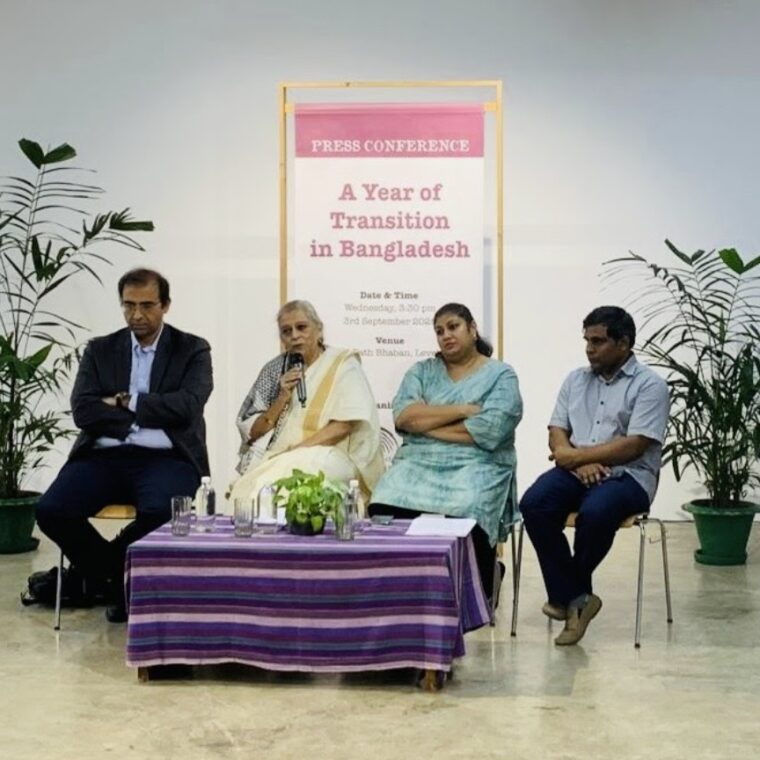

South Asians for Human Rights (SAHR), a regional network of human rights defenders, conducted a mission from 28 August to 3 September 2025 to understand the progress made by the Interim Government of Bangladesh in the aspects of promotion and protection of human rights and democratic values in their first year in office.
The South Asian delegation included Dr. Roshmi Goswami, SAHR CoChairperson, Saroop Ijaz, lawyer and SAHR member and Deekshya Illangasinghe, SAHR Executive Director.
The mission met with students, human rights defenders including those working on environmental rights and marginalised communities and other civil society representatives including academics, lawyers and journalists, members of various commissions and the Chief Advisor and several Advisors of the Interim Government.
SAHR applauds the courage, tenacity and energy of the youth of Bangladesh who led this spectacular uprising against the previous authoritarian regime and we hope that the spirit of the uprising is retained and the aspirations of the youth realised. However, it is equally important to be cautious in this period of transitional justice of the possible residual influence and pressures of the lengthy authoritarian regime and the extremist elements possibly misusing their newly gained freedoms that would in turn jeopardise and delay the proactive actions established by the Interim Government while serving the vast and numerous aspirations of the citizenship.
The mission highlights the following critical concerns:
1. There is a deep sense of insecurity and anxiety among the people of Bangladesh which needs to be immediately addressed
Due to the visibly declined law and order during the post July 2024 uprising leading to weakened public authority, the security forces have not been able to control the mob attacks, vigilante and reprisal attacks and other forms of lawlessness. Several murder charges on persons who have been arrested, accused persons being deprived bail, loop holes and delays in the due process and leniency on revenge justice also have aggravated the sense of insecurity among the masses.
The Interim Government has a responsibility to ensure the security of all citizens including minorities, and hold perpetrators accountable through an efficiently transparent and impartial investigation, upholding due process. The need for critical reforms in the judiciary, in the constitution and the police force therefore needs immediate attention and action.
2. The critical recommendations of the reform commissions must be implemented immediately to avoid democratic back sliding
It is commendable that the Interim Government succeeded in promptly setting up 11 reform commissions and the Consensus commission aligning with the aspirations of the people of the country. It is essential that at least the urgent short-term critical reforms are immediately implemented and enforced in order to smoothly regulate the administrative processes after the July uprising.
3. There must be a continuous strengthening of justice and redress provided to the victims and families affected by enforced and involuntary disappearances
Positive steps that have been taken by the Interim Government to bring justice and redress to those affected by enforced and involuntary disappearance within a year is remarkable. It is crucial that these measures at legal and administrative level are steadily pursued with the government support to achieve speedy accountability, redress and non-recurrence of this heinous crime.
4. The Interim Government’s ongoing use of draconian legislation developed by the previous authoritarian regime is concerning
Human rights community at national, regional and global level have unanimously advocated the repealing of these egregious laws such as the use of the Special Powers Act and the Anti-terrorism Act against political opponents and the Cyber Security Act persecuting the journalists, human rights defenders and dissenting voices. The Cyber Security Act been replaced with the Cyber protection Ordinance that still carries concerning provisions. In ushering in a climate of transformative change the mission believes that the first responsibility of the interim government would have been to halt using these draconian laws.
5. Attacks targeting minorities, their property and shrines in recent times have unnerved social sentiments
The establishment of a truly egalitarian society would ensure that especially vulnerable groups are protected. The deliberate targeting of Hindus, other Muslim sects like Ahmadiyya and Sufis, Adivasi communities in the plain land and in the Chittagong Hill Tracts, sexual minorities as well as women by religious groups, the military and organised mobs is of deep concern. It is worrying that women have become specially vulnerable in the present situation.
6. There is a heightened concern of conducting free and fair elections and a peaceful transition of power
This has been a strong aspiration of the people of Bangladesh. Therefore, it is important for the Interim Government to ensure to the public, a conducive environment for elections as well as a smooth transition of power amidst the complex landscape of numerous governing and administrative requirements aspired by the public in a short period prior to the election.
7. Rigorous restrictions on freedom of expression continues
It is regrettable that there have been large numbers of reports of killings, arbitrary arrests and intimidation of journalists in the past year. Right to information is a key component in the democratic process and cannot be curtailed. The civic space for Human Rights Defenders continues to shrink.
The Interim Government needs to take into account that a smooth and transparent transition towards a democratic process is important for the country at this crucial moment. It is of utmost importance that freedom of expression is absolutely safeguarded.
8. The National Human Rights Commission of Bangladesh (NHRCBD) and the Information Commission (IC) remains dormant
Even though they were established in 2009, the NHRCBD and the IC have never been independent public institutions in line with international standards with its inherent structural defects in the NHRC Act and the Right to Information Act. These institutions should be urgently made functional with strengthened Acts and an impartial selection process of commissioners to facilitate the dire need of promotion and protection of the rights of the people in the transition to a democratic process.
9. The issue of deeply polarised positions of members of civil society has resulted in the fragmentation of the civil society overall
In order to energise the aspirations of the people’s uprising, the mission views civil society as a critical and decisive stakeholder. Therefore, there is a need for civil society to take ownership and play a proactive role to strengthen the common agenda leading to a positive transformation.
On behalf of South Asians for Human Rights
Deekshya Illangasinghe
Executive Director
Bangla version can be found here.